The Direction of Safety-Critical Rust: Oxidize 2026

Known as 'The Applied Rust Conference', Oxidize focuses on industry, embedded and increasingly about using Rust in safety critical contexts.
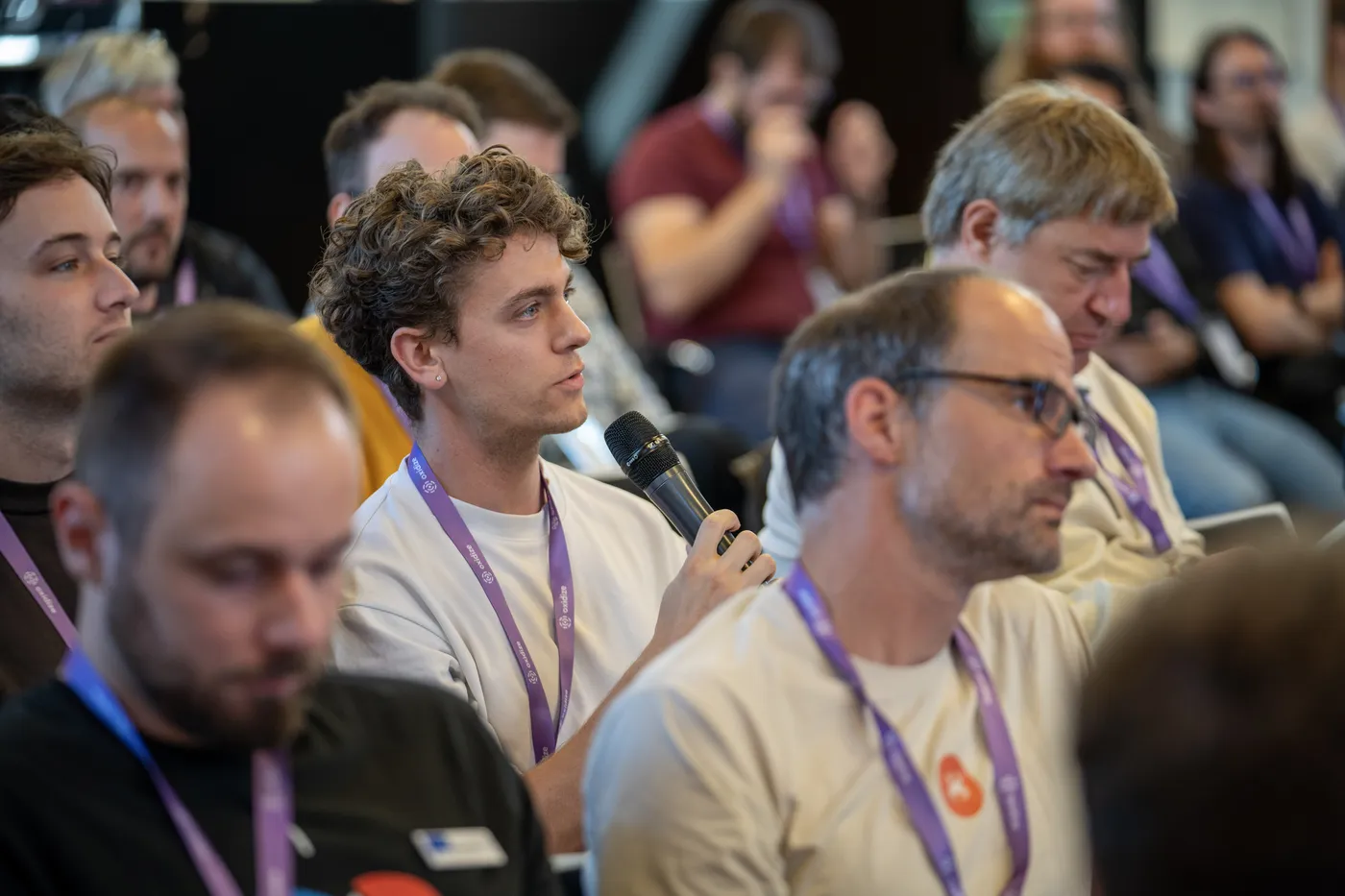
Running a Rust consultancy is pretty awesome. On a daily basis, I get to work on the most interesting problems, while getting to write solutions in a language that is durable, friendly and genuinely fun. To be able to keep doing this however, we always need to look ahead to remain a sustainable business: how is the industry adopting Rust? In which sectors do we want to operate? And why does Rust make sense there?
To answer these questions, Max and I find it important to not only represent Defined Once through our work, but to also meet with our peers in the field. Last week, we had the privilege to attend Oxidize 2026: the applied Rust conference in Berlin. What did we learn?
The Status of Embedded Rust
Developing embedded systems often comes down to squeezing out performance in resource-constrained environments, which has allowed C and C++ to arise as the de facto standard for embedded projects. While they were indeed revolutionary at the time, decades of embedded experience have enabled the creation of friendlier and more integrated tooling in the form of Rust's compiler, cargo and clippy. At Oxidize, fellow systems engineers reported that this has made development more fun and filled with less boilerplate. Engineering leads reported an increased productivity and a net reduction in the time spent on closing tickets*.
Be that as it may, it remains a persistent belief that the best possible performance can only be achieved when one manually controls everything (a la C). I consider this a false dichotomy between performance and safety: Rust does allow engineers to take the steering wheel and manage performance at the lowest level, just like C. Though, unlike C, the language allows us to clearly mark these potentially unsafe operations, and to build safe abstractions on top of them.
I am not the first to make this argument, and if you are already familiar with Rust, it may bore you a little. However, Embassy's rising popularity seems to indicate that such abstractions (like the HAL) are indeed well-suited to be (re)written in Rust. At Oxidize, various companies revealed that Embassy is powering embedded systems in a wide variety of domains: from electrical grid improvements to quantum computing hardware* and UAVs*.
Finally, Rust has found its way to European car manufacturers in promising multi-level battery technology that is expected to benefit both battery performance and durability*. As supporters of European sovereignty, we will keep following this topic closely.
When Software is Safety-Critical
In certain industries (e.g. railway, aerospace and automotive), software may be safety-critical meaning that it needs rigorous testing and certification before it can enter the market. Independent auditors assess whether or not the software
and coding practices comply with the relevant standards, which can be quite a lengthy process. To speed it up, Ferrous Systems has developed the Ferrocene compiler, a qualified compiler that enables certification to take place at the Rust source code level. In addition to that, crates like mantra make requirements engineering in Rust more palatable, further progressing tooling for software certification. At Oxidize, Sonair revealed that the Ferrocene compiler made software certification cost-effective, even for smaller startups*.
In the safety-critical domain, we see that competition is increasing as other qualified Rust compilers are entering the market (e.g. AdaCore and Hitex), which we expect to drive Rust adoption, and thus benefit the Rust community as a whole. There is still a lot of work to be done though; Oxidize emphasized once more that safety-critical Rust software is still at day zero.
Rust Deployment and Security
Numerous talks at Oxidize addressed the importance of Rust's interoperability with other languages (C, C++, Kotlin) and zoomed in on the FFI boundary (Foregin Function Interface). In practice, interfacing with other languages is quite common which leads to spending more time on topics such as cross compiling, platform support and type safety across the FFI*. However, throughout conversations at the conference, there was plenty of exchange about the various sharp edges of cross compiling and reproducible builds, giving a feel for what still needs improvement.
Furthermore, I was interested in fuzzing async Rust code, which still requires sacrifizing performance (and thus fuzzing throughput). During the several coffee breaks, async Rust remained a topic of discussion that invited many different opinions (should async be part of the standard library? should some code even be async at all? can async implementations be simplified to reduce binary sizes?). Sometimes it is remarked that async is a complete language on its own, which justifies the attention we give it.
Reflections
Similar to our reflections on RustWeek this year, we invite you to be a fly on the wall as we evaluate Oxidize 2026. This time, we discuss the workshops, presentations and panel talks, and the status of safety-critical Rust software.
*Unfortunately, not all recordings are available online yet. This blog will be updated with references when all recordings are published.