
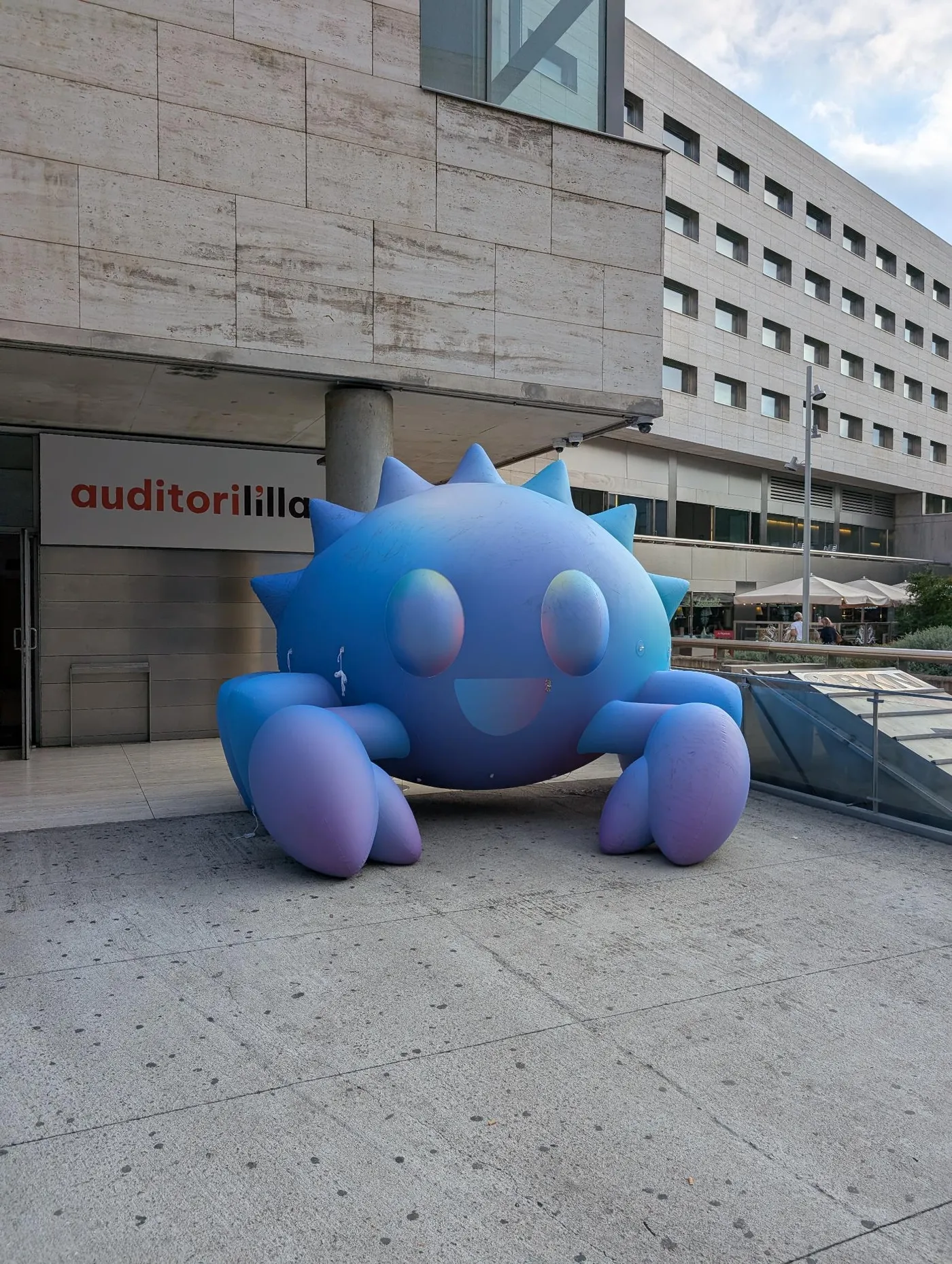
I have the pleasure and privilege of attending a number of Rust conferences each year and have found that they come in various flavors. At EuroRust, there was a particularly strong sense of community, care and curriosity. Conversations were technical, but also deeply personal which invoked new found comradery with fellow Rustaceans. The week spent in Barcelona was filled with learning about new technical concepts, enjoying the city and making new friends.
At the same time, it was an important moment for me and Elias to gauge which direction the language and community are headed, since this is a core part of our service. Understanding the Rust community is a vital in staying on top of the latest developments, getting a feel for timelines of project goals and, most importantly, understanding what is not being worked on. The following is a quick summary of the cental topics from the conference:
Shifting Left
While Rust has popularized the notion of solving problems at compile-time ("shift-left"), there are still some parts the language that don't fully embody this mentality. Oli Scherer opened EuroRust by remarking that there's long been demand for making reflection a native part of the language. However, he explains that it's a powerful feature that can be like opening Pandora's box if not designed against potential misuse. Another capability that is key to shift-left, is executing code at compile-time in a way that's ergonomic and plays well with the rest of the language. Zig set the precedent for this with comptime which is a strong inspiration for constant evaluation in Rust. At the time of writing, const traits are being actively worked on to bring a number of language features (such as for-loops) to compile time (project goal: Constify all the things).
Compile time guarantees was also a central topic in André Eriksson's talk where he presented Encore. The premise is as follows: Encore provides SDK libraries that expose a set of commonly used backend services for caches, databases, message queues, etc. Instead of defining these concepts in a configuration language that lives in parallel to the backend code, they are exposed to the language of the backend itself. This concept is rather powerful, since complete domain knowledge about the deployment can be checked at compile-time, bringing the confidence of the type checker into deployment.
Capital 'B' Build Systems
Jonas Kruckenberg made the distinction between build systems that are easy to maintain and ones that can scale. He argues that cargo is a complete batteries included build system that makes it easy to use and perfect for the majority of use cases. However, for his microkernel, he picked Buck2 (a capital 'B' build system) which unlocked the ability to scale dependency caching, even across remote machines. He closed with saying that the fundamentals of build systems are being redesigned and that it's an open space, with ample opportunity to innovate. Arya Dradjica presented an example of such innovation with Kraby an experimental Rust compiler that uses a more fine grained unit of compilation to improve caching. And Amos Wenger proposed yet another approach to build systems in his new language Vix, which hopes to bring cross langauge content addressed caching and much more.
Rust Adoption through Interoperability
Throughought the conference there were a number of talks that showed success interoperating with Rust. Shane Carr explained how Chromium is starting to enforce a boundary where user input data must always be processed by memory safe code. An example of this was integrating temporal_rs (a Rust date/time library) with the surrounding C++ environment inside the V8 Javascript engine. Similarly, Matthias Rauter demonstrated the developer experience for using Rust when building applications using Qt, the mature C++ UI framework. However, one challenge to interoperability is the targets supported by Rust. Arthur Cohen and Pierre-Emmanuel Patry address this through their work on gccrs which uses the native gcc backend to unlock support for a huge number of targets for Rust. Not all heroes wear capes!
Reflections
We've made it a tradition to gather our thoughts on a bench in public after the conference and invite you to listen in on our experiences through some long form content.